Changelog

Follow new updates and improvements to App Catalog.

Catalog App 1.11.3

🛠 Fixed

  • Macs could silently stop checking for updates: The update schedule was registered once during installation, and that registration could fail without reporting an error, most often when the package was installed while nobody was logged in. Nothing retried it, so the Mac never ran a scheduled update check again while continuing to look healthy in every other way. The schedule now ships as a regular background service inside the installer package, so installing and upgrading behave the same whether or not a user is logged in. Affected Macs recover automatically once they receive this version.

  • Permanent update prompt for apps without a version: Command line tools, uninstallers and anything that isn't an application bundle could show an update that never went away, because installing it couldn't change the outcome. These are now skipped, matching what the catalog command line tool already did.

  • App locations matched imprecisely during scanning: Excluded locations are now matched on path components instead of as text, so a folder whose name merely begins with an excluded path is no longer skipped.

👀 Changed

  • The command line tool leads with its subcommand syntax: The documentation, built-in help and generated deployment scripts now use the subcommand form, for example catalog install nl.root3.support. The familiar dash-style commands such as catalog --install keep working, so your existing scripts and MDM policies need no changes.

Catalog App 1.11.1

🛠 Fixed

  • Background services on macOS 27: On macOS 27, App Catalog's background services could fail to start after installation, stopping update checks, notifications and app installs. This is now fixed. You may need to manually update devices from App Catalog 1.11.0 to 1.11.1.

👀 Changed

  • Extra protection for background services: On macOS 14 and higher, App Catalog's background services now only start when they're signed by Root3.

Update Reminder Styles, prominent alerts and more

✨ New

App Catalog 1.10.0

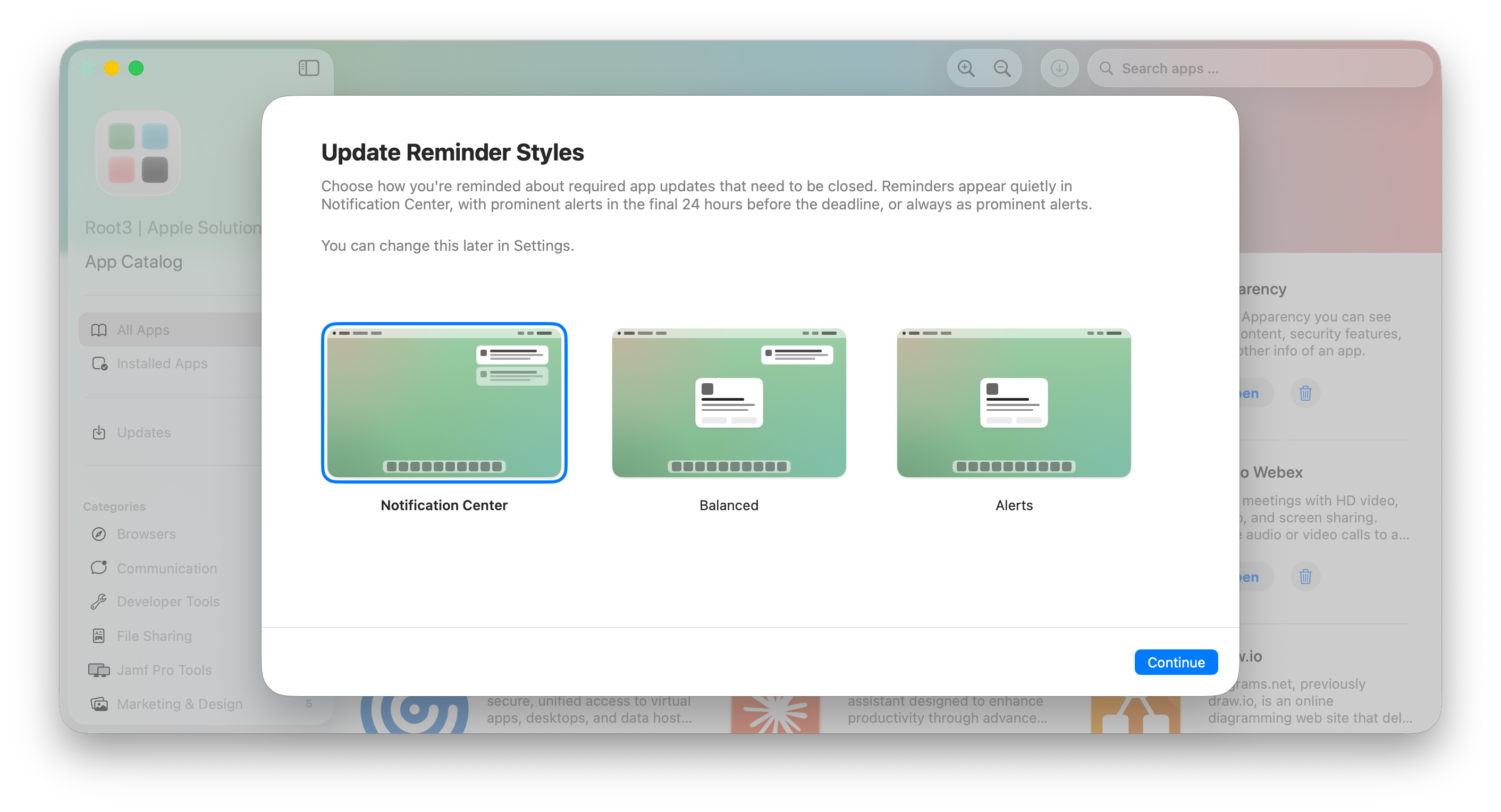
  • Update Reminder Styles: App Catalog now offers three styles to remind you about required app updates that need their app to be closed:

    • Notification Center (default): Reminders appear in Notification Center, like a regular notification. They respect Do Not Disturb and Focus, so they won't break your concentration. Best if you want updates to wait their turn and less interruption for your workflows.

    • Balanced: Reminders stay in Notification Center until the deadline gets close. In the final 24 hours before the deadline, they switch to a prominent alert in the middle of the screen so you don't miss it. A good middle ground.

    • Alerts: Every reminder appears as a prominent alert in the middle of the screen. The most visible option, and the one most likely to interrupt what you're doing. Best if you'd rather act on updates straight away.

    • More information: User deferrals & interaction

  • Allow users to choose or define an organization-wide policy:

    • By default, users will be able to choose the update reminder style that best fits their workflow. Choice will be offered when they open Catalog App and can be changed later in the app settings. We believe every person has its own way of working and being productive. That’s why we recommend letting people choose.

    • If required, administrators can enforce a single style organization-wide via the UpdateNotificationStyle preference. The user will not be prompted to choose and the setting cannot be altered.

    • More information: Preference Keys - Catalog Agent

Choosing Update Reminder Styles in Catalog App

👀 Changed

  • Reminder lifecycle logs are retained in Unified Logging and now include the presentation style (Alert or Notification Center) and reminder type for easier diagnostics.

🛠 Fixed

  • Notification Center action button labels are localized with English fallback: The "Update now" and "Later" buttons under the notification (Notification Center actions) previously fell back to localized string (UPDATE_NOW) in non-supported languages. They now fallback to English.

  • Notification reliability is improved

  • Minor spacing issue resolved in the “Updates” UI

Earlier updates